Industry News
 2026.11.13
 Industry News
Home grooming has become part of everyday personal care, as more people look for convenient ways to maintain their appearance between salon visits. When choosing a USB Rechargeable Hair Clipper, blade material deserves attention because it influences cutting smoothness, wear resistance, heat transfer, and upkeep. The cutting experience also depends on motor performance, blade alignment, and overall construction, so no single feature settles the question. Understanding these differences helps buyers select a clipper that fits their habits, whether they want a simple home haircut or a more controlled styling routine.
A clipper works through the interaction of a moving blade and a stationary one. The two edges pass over each other as the motor drives the cutting assembly, and hair is cut where they meet. Material properties decide how those edges behave over repeated use. A suitable material supports consistent cutting, resists surface wear, and tolerates regular cleaning. A poorly matched pair, or one made with inaccurate tolerances, contributes to pulling, uneven trimming, and an uncomfortable session.
Sharpness helps, but it is not the only factor. Edge geometry and surface finish also decide how easily the blades pass through hair. A well-finished edge reduces resistance, and blades that fit together accurately give a more controlled cut. This shows up in ordinary tasks such as trimming around the ears, shaping sideburns, and keeping a short style tidy, especially for people cutting their own hair, where control matters more than speed.
Strength matters over time. Repeated contact slowly wears blade surfaces, and a material with suitable hardness keeps its edge longer. Corrosion resistance counts as well, since clippers meet hair fragments, skin oils, moisture, and cleaning products. Buyers should weigh material quality together with blade construction and the maker's care instructions.
Clippers commonly use stainless steel, ceramic, or steel with a surface coating. Each brings different characteristics and care needs.
Stainless steel is widely used in grooming tools because it combines strength with corrosion resistance. It handles everyday moisture, works with many blade designs, and is simple to clean. For a household that shares one clipper, it offers a familiar balance of durability and low fuss. Grades and manufacturing processes vary, though, and edge treatment and geometry still shape the result.
Ceramic blades are valued for hardness and corrosion resistance. Their relatively low thermal conductivity means heat moves through them differently from steel, which can limit heat transfer through the cutting surface during use. Ceramic is also more brittle than steel and can chip or crack if dropped, so careful handling is part of owning one.
Titanium-coated blades usually have a steel body with a coating on the surface. The steel supplies the strength, and the coating can improve resistance to wear when well made. How it performs depends on the steel beneath, the coating's thickness and consistency, how well it bonds to the base, and the precision of the edges. A coating alone does not guarantee a better cut, so look at the whole assembly instead of a label.
Carbon steel can hold a hard edge and suit precise trimming, but it needs more attention to moisture than stainless steel. Clean the blade after use, dry it before storage, and lubricate it as directed. For people comfortable with regular blade care, it remains a useful option.
| Blade Material | Main Characteristics | Maintenance Considerations |
|---|---|---|
| Stainless steel | Strength and corrosion resistance | Regular cleaning and lubrication |
| Ceramic | Hardness and low thermal conductivity | Careful handling to avoid chipping |
| Titanium-coated steel | Steel body with a coated surface | Check coating condition, clean regularly |
| Carbon steel | Hard edge, precise trimming | Keep dry and maintain often |
Actual performance within each group depends on grade, processing quality, blade geometry, and assembly precision.
Material influences several parts of the experience, though not in isolation. Hardness helps an edge resist deformation, and a stable edge supports consistent trimming across many sessions. A hard material still does not guarantee a smooth cut. Edge geometry, alignment, surface finish, motor stability, and the fit between moving and stationary blades all play a part, and when they work together the clipper meets less resistance.
Heat develops through friction between moving parts and contact with hair. Ceramic and steel differ in how they conduct it, yet the real operating temperature also depends on motor design, blade contact, lubrication, and ventilation. For longer sessions, look at the whole cutting assembly rather than choosing on material alone. If a blade feels uncomfortably warm during use, pause and let it cool, and add a drop of the recommended oil.
Sound matters at home, particularly in flats and shared houses where a clipper running early in the morning can disturb others. Blade material affects friction and contact behaviour, but the motor and mechanical structure usually have a larger influence on how loud the clipper is. A Low Noise Hair Clipper should therefore be judged by its whole construction. Stable motor operation, accurate blade alignment, secure internal assembly, vibration control, and proper lubrication all contribute. A well-matched blade assembly runs smoothly, while a poorly fitted one produces extra vibration and mechanical noise.
The motor drives the blades, and the internal structure decides how vibration travels through the housing, so a good design considers both. Grip shape, weight, button position, and balance matter too, because a comfortable clipper is easier to control when trimming the back of the head or the neckline.
The right material depends on how often the clipper is used and what the user expects.
Stainless steel suits regular household grooming. For families doing routine haircuts and touch-ups, it combines strength and corrosion resistance without complicated care. Ceramic may suit people who pay attention to blade temperature, provided they handle it with care and protect it from drops. Titanium-coated steel appeals to buyers interested in surface protection, though the steel beneath and the manufacturing quality remain important, so check whether the product gives clear construction details rather than coating claims only.
Features around the blade shape the overall experience as well.
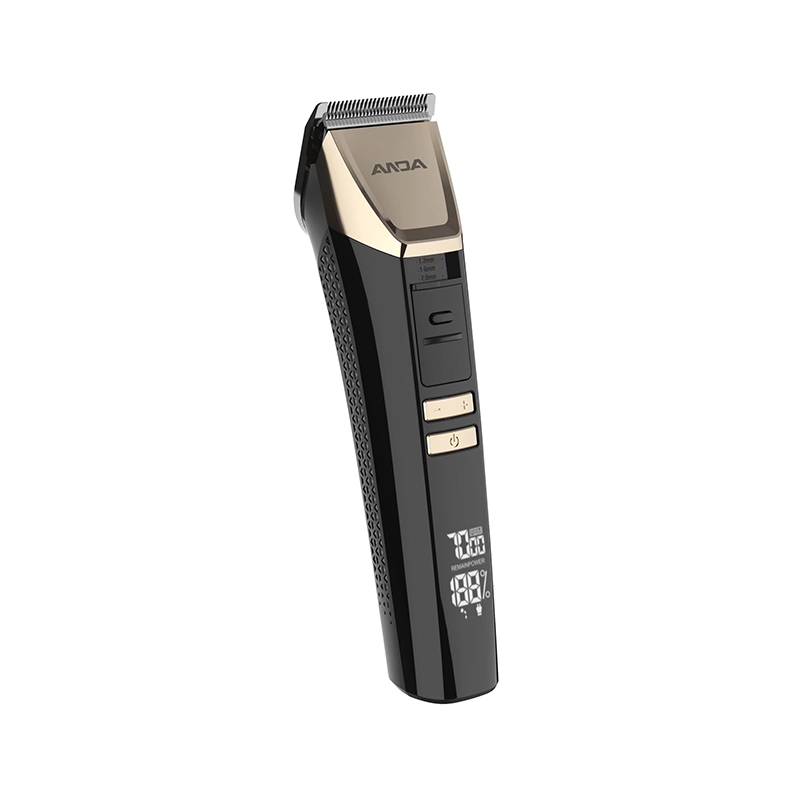
An LCD Hair Clipper adds a screen that shows useful information, such as battery level or charging progress, depending on the design. That helps when several family members share the device, because the remaining charge can be checked before a haircut begins. It reduces interruptions from unexpected power loss, and it makes a clipper kept in a bathroom cabinet or drawer easy to check at a glance. A screen should simplify use. Readable battery information, clearly placed display elements, an accessible power button, and a comfortable layout in the hand all matter. The display complements the blade assembly, but it does not decide cutting quality.
Cordless equipment fits modern routines. Without a fixed power cord, users move freely while trimming, and a USB Rechargeable Hair Clipper suits people who already charge other devices through USB. Charging flexibility helps travellers and anyone who keeps grooming tools in different rooms. Before buying, check the charging connector, power requirements, and compatibility information from the maker.
Battery capacity alone does not describe the cordless experience. Motor efficiency, operating speed, battery condition, and cutting resistance all affect real use. When evaluating a rechargeable model, ask whether the battery covers your usual routine, whether charging is straightforward, whether battery information is clearly shown, and whether the clipper runs steadily in normal use.
| Feature | What It Adds | What to Check |
|---|---|---|
| LCD display | Battery and charging information | Readable layout, easy button access |
| USB charging | Flexible charging at home or away | Connector, power requirements |
| Low noise design | More comfortable use in shared homes | Motor, alignment, vibration control |
| Blade material | Cutting feel and wear behaviour | Grade, finish, care needs |
Regular care protects the blade surface and keeps cutting reliable. Even a well-made blade loses quality when hair fragments, moisture, or too little lubricant affect the assembly.
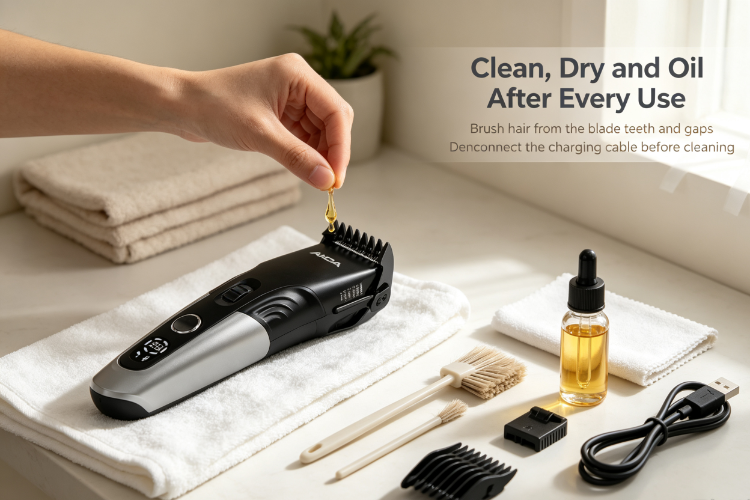
Brush hair from the blade teeth after each use, paying attention to the gaps between moving and stationary blades. Apply clipper oil according to the instructions, since a small amount reduces friction and keeps parts moving smoothly. Remove moisture after cleaning, especially on steel blades, and avoid storing the clipper in damp places. Inspect the assembly from time to time for visible damage, unusual movement, or excessive wear, and if a blade is damaged or no longer cuts properly, follow the maker's replacement guidance instead of continuing to use it. Disconnect the clipper from the charging cable before cleaning.
Buyers and distributors evaluating a product or supplier should discuss available blade materials and their intended use, finishing and assembly precision, motor configuration and operating sound, battery and USB charging arrangements, display functions and control layout, and cleaning and replacement needs. A thoughtfully designed LCD Hair Clipper, a well-judged USB Rechargeable Hair Clipper, and a considered Low Noise Hair Clipper each combine blade quality with the features around it, and consumers experience them as one device, from checking the battery to cleaning the head after a haircut.
Recommended Products

No.377. Fourth Avenue, Binhai Park, Economic-Technological Development Zone, Wenzhou, Zhejiang, China.

+86-577-88912812

+86-577-88912822

anda1@andaelectric.com
anda6@andaelectric.com
anda7@andaelectric.com
Copyright © Zhejiang Anda Electric Co., Ltd. Rights Reserved.
Electric Hair Clipper Manufacturer



 English
 Español
 русский